Blogia
javierdelgado

AJEDREZ, GO, XIANGQI...

GO EN JAPÓN: VIDEO DE UNA CLASE DE GO PARA NIÑOS EN JAPÓN

<object width=

GO: COMPITEN POR EL TÍTULO KISEI 2008

GO: COMPITEN POR EL TÍTULO KISEI 2008

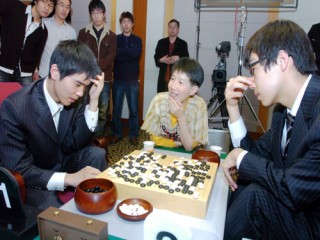
Estos dos son los jovencísimos grandes maestros de Go que están compitiendo por el título Kisei 2008:

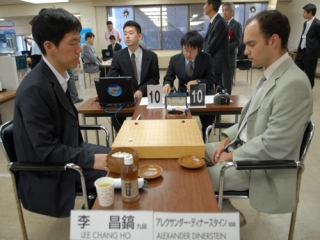
Cho Chikun contra Yamashita Keigo.

Pueden verlo en la web de la Federación Koreana de Go:

http://www.baduk.or.kr/news/

GO EN LA RED: UNA ESTUPENDA COLECCIÓN DE PARTIDAS DE GO COMENTADAS

GO EN LA RED: UNA ESTUPENDA COLECCIÓN DE PARTIDAS DE GO COMENTADAS

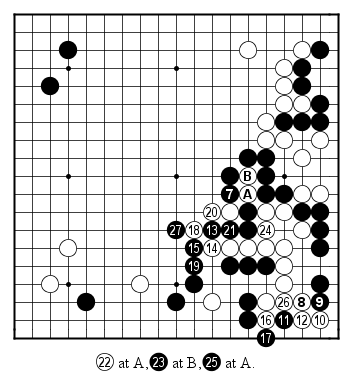
El ejemplo está tomado de la web de Sorin Gherman,

entrada de hoy viernes 29 de febrero 2008.

Se trata de la partida del campeonato Kisei ganada por Cho Chikun

contra Yamashita Keigo en su lucha por el título Kisei 2008.

(Kisei game 5 ended with Cho’s 3.5 points victory).

 Lo que me importa señalaar hoy es que el sabio Sorin Gherman

ofrece en su web varias colecciones de partidas comentadas

en las que puede aprenderse mucho sobre la forma contemporénea de jugar al Go.

Está en:

http://www.361points.com/kifu_sorin/

CAMPEONATO DE ESPAÑA DE GO (EN MADRID)

CAMPEONATO DE ESPAÑA DE GO (EN MADRID)

El  fin de semana del 9 de febrero se celebró en Madrid, concretamente


en el Círculo Catalán el Campeonato de España de Go,

cuyo vencedor resulta Campeón de España y


representante español para el torneo amateur mundial realizado en Japón. 
 

Puede obtenerse información de las partidas de los 8 finalistas de este año.

 en la web del Club de Go Nam-Ban, que forma parte del Círculo Catalán de Madrid,

principal club de Go (weiqi, baduk) de Madrid.

Allí, además, se pueden pinchar las partidas para verlas:

 http://www.clubgomadrid.org/activities/2008_final_sp.php).

Se trata de las partidas de más alto nivel

que pueden verse hoy en día en España. 


HAN SANGHOON, CAMPEÓN DEL MUNDO DEL WORLD GO CHAMPIONSHIP

HAN SANGHOON, CAMPEÓN DEL MUNDO DEL  WORLD GO CHAMPIONSHIP

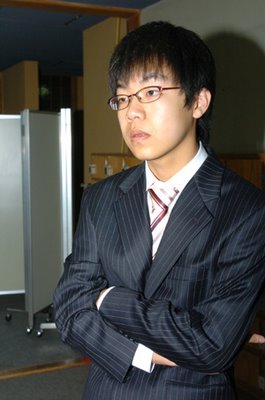
 Han Sanghoon

 An interview with Han Sanghoon, 1-dan, the first 1-dan in Go history, who entered the final match of the World Go Championship (LG cup).

De toda la entrevista que le hacen en "World Go News"

(http://go-news.blogspot.com/2007/12/interview-with-han-sanghoon-1-dan.html)

lo que más me ha impresionado es su sincero reconocimiento de capacidades y dificultades:

What are your weakest and strongest parts in Go?
I am weak at the opening, but I feel myself confident in middlegame fights. Usually I try to defend my groups solidly, before fighting.

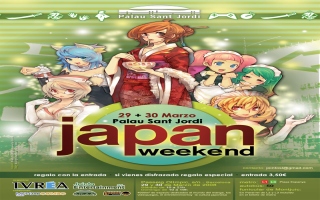
UN FIN DE SEMANA DEDICADO A LO JAPONÉS, CON COMPETICIONES DE GO Y SHOGI INCLUÍDAS

UN FIN DE SEMANA DEDICADO A LO JAPONÉS, CON COMPETICIONES DE GO Y SHOGI INCLUÍDAS


 Más información en:

http://www.infotaku.com/Article3955.html

GO WORLD ARCHIVE VOLS. I -I II, NOS. 1-108 AHORA EN DVD

GO WORLD ARCHIVE VOLS. I -I II, NOS. 1-108 AHORA EN DVD

Go World Archive Vols. I-III, Nos. 1-108

This 3-DVD set of Go World Archive contains the first 30 years of Go World magazine, the English world's premier source of go information, on three DVDs. Includes rare early numbers no longer available. Lovingly scanned to maintain the exact look and feel of the original. Contains a wealth of game commentaries, articles, problems, and news. Extensive index and full-text search is available across the entire archive of nearly 7000 pages. Can be used on any computer with a DVD drive and Adobe Reader software.

precio 99 dólares USA

Title #226671
Format: DVD-R

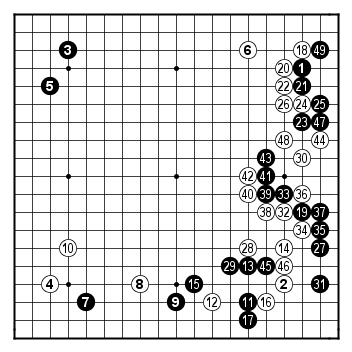
UN EJEMPLO DE LOS COMENTARIOS SOBRE PARTIDAS DE GO QUE PUBLICA EN SU ESTUPENDO BLOG EL SABIO SORIN GHERMAN

UN EJEMPLO DE LOS COMENTARIOS SOBRE PARTIDAS DE GO QUE PUBLICA EN SU ESTUPENDO BLOG EL SABIO SORIN GHERMAN

Kisei Title, game 5, day 1 February 27th, 2008

Game 5 of the Kisei title started today: Cho (Black) played the last move of day one (49, in the upper-right corner) before Yamashita sealed his next move.

While Cho cannot afford to lose any other game, Yamashita has a comfortable 3-1 lead so he only needs to win one of the next 3 games (including this one) in order to win this match and keep the title.

Black seems to have more territory, but he also has several groups on the right hand side to worry about. The game will continue tomorrow.

De trata del título del campeonato Kisei 2008, en el que Yamashita defiende su título frente a Kobayashi Satoru

....

La dir. de su blog: http://www361points.com/blog

Ya he puesto un link.

También al sitio de Alexandre Dinerchtein.

TRES NUEVOS SITIOS SOBRE GO DEL SABIO ALEXANDRE DINERCHTEIN

TRES NUEVOS SITIOS SOBRE GO DEL SABIO ALEXANDRE DINERCHTEIN
Alexandre Dinerchtein me comunica que tiene también otros tres sitios sobre Go:
play.baduk.org
style.baduk.org
find.gogame.info
El segundo es especialmente interesante: se trata de un test de juego gracias al cual se puede conocer cuál es tu estilo, tus virtudes y tus deficiencias. Además, Alexandre sugiere el estudio de las partidas comentadas que considera oportunas a cada jugador que ha realizado el test.
El tercero también es muy interesante para quienes buscamos en la Red sitios sobre Go: Alexandre sufre, como tod@s, el problema que genera en las búsquedas la palabra Go (Ir, en inglés), palabra que desorienta absolutamente nuestras búsquedas y nos impide acceder a muchísimos sitios que tratan del Go. Él se propone en ese sitio recopilar direcciones de sitios en los que se trate el Go suficientemente y con cierta calidad (no explica en qué basa sus juicios). Viene muy bien como "agenda" especial sobre sitios de Go en nuestros "Favoritos".

IGOR GRISHIN: OTRO SABIO RUSO DE GO, DIRECTOR DE UNA BUENA REVISTA ONLINE Y TIPO, AL PARECER, DE MUY BUEN HUMOR, QUE TAMBIÉN IMPORTA

IGOR GRISHIN: OTRO SABIO RUSO DE GO, DIRECTOR DE UNA BUENA REVISTA ONLINE  Y TIPO, AL PARECER, DE MUY BUEN HUMOR, QUE TAMBIÉN IMPORTA


En esta dirección: Igor Grishin

http://gogame.info/index.html

 Pueden entrar en la revista Goama, que dirigen dos rusos divertidísimos y muy sabios en esto del Go: el ya citado en otro post Alexander Dinerchtein y este Igor Grishin de la foto.

Así se presenta en la revista:

Director of the project:

Igor Grishin
President of the Go Federation (Russia, Moscow)
Director of “Voshozdenie” Go&Wushu children’s school in Moscow.
Mr Grishin has been playing and teaching Go since 1990. He received a 3-dan diploma from the Chinese Weiqi Association in 2002. He is one of the top Go masters in Moscow.
Igor is the author of several Go books, and the sponsor and organizer of the largest tournaments in Russia and on KGS. His homepage is: http://goama.upstream.ru/club/members/grishin.htm

Su página personal debe de muy interesante también, pero está en ruso y en caracteres cirílicos, así que no, esta vez no he podido entender nada de lo que pone ahí. Por ejemplo y por pura curiosidad:

 Я занимаюсь преподаванием с 1989. Начинал как инструктор боевых искусств. Тренировал и детей и взрослых. И к той и к другой категории учеников требуется свой подход. Лишь немногие педагогические технологии универсальны.

Я постоянно нахожусь в поиске, и стараюсь давать только тот материал, который порождает творческое стремление, в том числе и во мне самом.

В год я могу обучить до трех человек взрослых. Не более.

Я не могу делать это бесплатно, и стоит это недешево. Можно даже сказать – дорого. Для тех, кто не может платить столько, сколько это стоит, я провожу семинары, где знакомлю со своим подходом. Семинар продолжается 3 часа. Предварительная запись обязательна.

Осенью я провожу один семинар для тех членов школы Восхождение нашей Федерации Го. Один семинар - по Го (он носит название целостное видение го ), а другой - по боевым искусствам.


ALEXANDRE DINERCHTEIN: UN MAESTRO (COMO JUGADOR Y COMO DOCENTE) RUSO DE GO, MIEMBRO DE LA MUY IMPORTANTE ASOCIACIÓN COREANA DE GO

ALEXANDRE DINERCHTEIN: UN MAESTRO (COMO JUGADOR Y COMO DOCENTE) RUSO DE GO, MIEMBRO DE LA  MUY IMPORTANTE ASOCIACIÓN COREANA DE GO

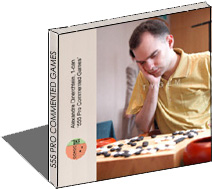
 Portada del CD de partidas de Go comentadas

Alexandre Dinerchtein tiene su propia escuela de Go en la Red.

Así se presenta:

The first Russian Go game professional, the member of the Korean Baduk(Go) Association, will be glad to find new Go students.
During my Go lessons I will not show you how to make the ideal shapes or get pleasure from your moves.
I will teach you how to win your games!
English, Korean and Russian Go players, looking for Go teacher are welcome!

Ha editado, entre otras cosas, un CD de partidas comentadas que está muy bien:

"555 PRO COMMENTED GAMES" ON CD,
VOLUME 1 (2003-2004),
VOLUME 2 (2005-2006)
The collection features 555 of the most exciting professional and high-level amateur games.
All games are commented in detail by Alexandre Dinerchtein, 1-dan professional of the Hankuk Kiwon (Korean Baduk Association).
The database was compiled by Dmitrij Bogatskij using BiGo Assistant.
All features of BiGo Assistant - including full-board, three-quarter and half-board searches, detailed statistics, fuseki and joseki databases, searches by name, rank, date, and position - are available.
The program is suitable for amateurs from 10 kyu to 5 dan.

© 2003-2006 Alexandre Dinerchtein.
© 1998-2006 BiGo Software. All rights reserved.

Price: 30 usd each*

* A partir de hoy pondré los textos que copie en sus idiomas originales. Quienes navegamos por la Red nos comunicamos en inglés, alemán, castellano, francés, italiano...  y el espíritu de este blog es internacionalista y multilingüe.

"HIKARU-NO-GO": UN COMIC MANGA SOBRE UN MUCHACHO QUE APRENDE A JUGAR GO...Y MÁS COSAS

"HIKARU-NO-GO": UN COMIC MANGA SOBRE UN MUCHACHO QUE APRENDE A JUGAR GO...Y MÁS COSAS

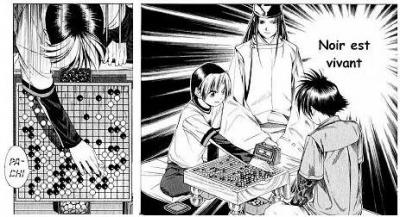
 Esta es la portada del número 9 de la colección de historietas manga. Ya han salido muchos números más.

Hikaru-no-Go manga

Famosísima colección que se edita en muchísimos idiomas (no en español) y que hace furor en la gente joven de todo el mundo. En las aventuras de Hiraku hay siempre tiempo para las partidas de Go, importantes partidas de la historia del Go cuyos detalles los estudiosos se encargan de desvelar en la Red.

"Hikaru no Go" es un manga japonés acerca de un chico llamado escuela Shindo Hikaru, que se convierte en un jugador profesional de Go en el Japón. Él se interesa por Ir misteriosamente conseguir en contacto con Fujiwara-no-Sai, el espíritu de un jugador muy fuerte Vaya que vivió hace cientos de años.

Compré ejemplares por Internet, pero puede que consigan adquirirla a través de la estupenda tienda de cómics zaragozana "Taj Mahal", Juan Pablo Bonet, 16.

"INVINCIBLE: THE GAMES OF SHUSAKU: UN COMENTARIO DEL SABIO BLOGUERO SORIN GHERMAN

Traduzco del blog de Sorin Gherman
http://www.361points.com/guide_to_go_books/
"Invincible: The games of Shusaku"

Esta es una colección de partidas de uno de los más famosos jugadores de la historia Go, Honinbo Shusaku. Todos los jugadores profesionales de Go en el Japón han estudiado las partidas de Shusaku en algún momento de su carrera. El nombre de Shusaku debe ser  conocido por todos los aficionados al Go, ya que Shusaku fue "el anterior Hikaru", en otras palabras, el espíritu de Sai fue comunicar Shusaku a los jóvenes, así como lo hizo con Hikaru - sólo unos pocos cientos de años atrás en el tiempo.
Así comenta el sabio blogero Sorin Gherman este magnífico libro en el que se hallarán antiguas pero brillantes joyas del Go sobre las que reflexionar siempre.

http://www.361points.com/blog/: UN BLOG ESTUPENDO SOBRE EL JUEGO DEL GO:

http://www.361points.com/blog/:  UN BLOG ESTUPENDO SOBRE EL JUEGO DEL GO:


Como no me da para más, paseo por la Red.

Y encuentro este magnífico blog sobre el juego de Go:

http://www.361points.com/blog/

Lo firma Sorin Gherman, que se presenta así:

 Hi all! My name is Sorin Gherman. I studied Go as an insei in Japan,

and I built 361points.com to share my Go experience with you.

 En su blog hay links a los siguientes blogs dedicados al Go:

    Ziggy's Go Club
                  (A los que añado este otro link a otro blog que también me ha gustado:

                http://www.slateandshell.com/BillCobbEmptyBoard1.asp 

                o lo que es lo mismo:

                The Empty Board

                by William Cobb )

                 Sorin Gherman también comenta con sabiduría y experiencia diversos títulos de aprendizaje y divulgación del Go.

                ¡Anímense!

                (¡Miren quién se lo dice!)

                "LA VIE DU GO" ,UN LIBRO IMPORTANTE

                "LA VIE DU GO" ,UN LIBRO IMPORTANTE

                LA VIE DU GO: UN LIBRO IMPORTANTE

                El libro de Flore Coppin y Morgan Marchand "La vie du Go. Propos sur le jeu de Go" (Chiron, 2006) es un libro estupendo, el mejor que he leído por ahora sobre las implicaciones profundas de la reflexión vital implícita en el Go. Desde luego, el mejor en lengua francesa desde que se editara el ya clásico y mítico "Petit traité invitant à la découverte de l'art subtil du Go" de Pierre Lusson, Georges Perec y Jacques Roubaud (Christian Bourgois, 1969, 2ª ed de 2003).

                Habaremos más adelante sobre este maravilloso libro.

                Entretanto, ¡háganse con un ejemplar!
                (Yo lo compré por Internet).

                EL BLOG DE LA SUPERAJEDRECISTA SUSAN POLGAR

                El blog de la superajedrecista Susan Polgar, hija del sabio ajedrecista Laszlo Polgar y hermana de la  grandísima ajedrecista Judith Polgar, de los Polgar de su mismísmo origen.

                Un blog lleno de sabiduría y humor.

                http://susanpolgar.blogspot.com/

                EL AJEDREZ Y EL GO: DOS MODELOS ESTRATÉGICOS DISTINTOS

                EL AJEDREZ Y EL GO: DOS MODELOS ESTRATÉGICOS DISTINTOS

                 Las consecuencias de formarse sobre modelos estratégicos basados en el Ajedrez y/o sobre modelos basados en el Go está siendo estudiada desde hace bastante tiempo (años sesenta), pero en la actualidad, debido seguramente a una mayor difusión del Go en occidente, la atención es cada vez mayor. Porque se llegan a interesantes conclusiones.

                Este texto de Josef Pieper me acaba de llegar de un foro de Internet y es representativo de la mirada actual sobre el asunto.


                Josef Pieper  
                View profile
                 More options Nov 10, 4:35 am
                Newsgroups: rec.games.chinese-chess
                From: Josef Pieper ...@bluebottle.com>
                Date: Fri, 09 Nov 2007 22:35:14 -0500
                Local: Sat, Nov 10 2007 4:35 am
                Subject: Eastern Mind vs. Western Mind: Go vs. Chess/Xiangqi
                     To Whom It May Concern:
                        I have been researching the question of habits of mind and culture as
                being promoted by and/or reflected by certain board games.  In
                particular, I have been investigating whether weiqi/go is representative
                of the “Asian mind” and whether international chess is representative of
                the “Western mind.”
                     Apparently, I am not alone in raising this question.  Analysts in
                political and military fields have been suggesting that weiqi/go, in
                particular, is emblematic of a particularly Chinese world view, rooted
                in Chinese philosophy and the Chinese practice of diplomacy and war.  In
                contrast, international chess (along with poker, boxing and American
                football), have been proposed as expressive of a generically Western and
                particularly American world view, grounded in assumptions about conflict
                systematized in a magisterial fashion by Carl von Clausewitz in the 19th
                century (with roots going back much further) and largely vindicated by
                American experience throughout the 20th century and still being refined
                by Americans in the 21st century.
                     The writers I have reviewed argue that achieving “victory” depends
                upon which “game” one is playing.  Paradoxically, one’s opponent may be
                playing an entirely different game.  One is ignorant of such a datum at
                one’s peril.  Specifically, Americans have been playing chess, poker,
                boxing and football (as examples of “force on force” games) in military
                and diplomatic arenas, while the Chinese have been playing weiqi/go.
                Consequently, the future may well belong to the Chinese, as weiqi/go
                emphasizes the wisdom of long-term strategy and planning and the rich
                rewards of patience.  Several authors urge the West, and Americans in
                particular, to familiarize themselves with weiqi/go and thereby the
                Chinese mind, in order to understand and compete with an opponent who
                might otherwise be incomprehensible and therefore undefeatable.
                     In pursuing this line of research, I have made use of a martial
                arts analogy.  I've read that one can develop a Tai Chi body and state
                of mind, or a Hsing-I body and state of mind or a Ba Gua body and state
                of mind.  Do weiqi, xiangqi (Chinese chess) and international chess,
                mutatis mutandis, develop states or habits of mind and cultures that are
                unique to them?  If I were to force the analogy, I would say that weiqi
                is like Tai-Chi, with fluid movements.  International chess is like
                Hsing-I with its direct lines of attack and its emphasis on control of
                the center.  Xiangqi is like Ba Gua with its emphasis on maneuver.
                As recently as 2004, the Strategic Studies Institute published a
                monograph that exhorted the study of weiqi/go as a means of
                understanding strategic conflict with China.  I trust that you will find
                this excerpt to be illuminating:
                     “The philosophy behind chess is to win decisively. For the winner,
                victory is absolute, as is defeat for the loser. In chess, both players
                have the same clear and overriding objective―capturing the opposing
                king―and accomplish this objective by decimating whatever opposing
                forces are standing in the way. In go, total victory usually happens
                between two mismatched players. That kind of victory, as Sun Tzu puts
                it, is not the pinnacle of excellence. In a go game between two
                well-matched players, the margin between win and lose is usually very
                small, often decided by only a few points.  The philosophy behind go
                therefore is to compete for relative gain rather than seeking complete
                annihilation of the opponent’s forces.  It is dangerous to play go with
                the chess mindset. One can become overly aggressive so that he will
                stretch his force thin and expose his  vulnerable parts in the battlefields.
                     In chess, the focus is on the king. All the moves are geared toward
                checking the king. In designs to capture the king, chess players always
                try to eliminate the powerful pieces such as the queen, knight, castle,
                and bishop. Chess players typically focus on these powerful military
                units as the ‘center of gravity’ and ‘decisive point’ (in Clausewitz and
                Jomini’s terms). Naturally, chess players are single-minded. In go, it
                is a war with multiple campaigns and battlefields. There is no one
                single focus on the board. A go player must always keep the whole
                situation in mind. Attacking the opponent’s strategy therefore is much
                more appropriate in go. As a prolonged and complex game, go players
                focus on building or creating rather than chess players’ emphases on
                removal and destruction.”   (David Lai, “Learning From The Stones:  A Go
                Approach To Mastering China’s Strategic Concept, Shi, pp. 28-29)
                     As early as 1969, a junior fellow of the Society of Fellows of
                Harvard University advocated the exploitation of a weiqi/go paradigm
                (“the protracted game”) as a means of at least understanding if not
                contending with Maoist China (and by implication, Vietnam):
                “Any school of strategic thought, whether Chinese Communist or
                Clausewitzian, contains two intellectual elements:  on the one hand,
                universal pan-strategic principles; on the other, axioms which are the
                distinguishing features of the particular system and which represent the
                empirical and subjective conclusions of its exponents.  The function of
                the wei-ch’i model is to provide a systematic methodology for analyzing
                and structuring the contingent elements of the Chinese Communist
                strategic system.
                     The importance of this function may be illustrated by the following
                passages from an essay Fung Yu-lan, one of modern China’s leading
                philosophers.  As already mentioned, the hsiang-ch’i referred to is the
                Chinese equivalent of Western chess; both wei-ch’i and hsiang-ch’i are
                generically called ch’i.  Wrote Fung:

                ‘Wei-ch’i has wei-ch’i rules; hsiang-ch’i has hsiang-ch’i rules.  If one
                is playing wei-ch’i then one is bound by wei-ch’i rules; and likewise
                for hsiang-ch’i.  Nor is it necessarily a matter of choice what form of
                ch’i is played.  Stones and grid-board are necessary prerequisites for
                wei-ch’i; the chessmen and the eighty-one squares, for hsiang-ch’i.’

                     Turning to the shortcomings of the Chinese intelligentsia of the
                early republican period who failed to recognize the problems of Chinese
                society, Fung proceeds:

                ‘This is just like someone who only knows how to play wei-ch’i and who
                does not know that there is more than one kind of ch’i, who, when he
                sees the opening position in hsiang-ch’i, cries, “How can you start like
                this?  You’re wrong, you’re wrong!”  Again, seeing a piece move, he
                criticizes, “How can you move a piece already played?  You’re playing
                illegally.”  When the wei-ch’i people of this world, who don’t know
                hsiang-ch’i, criticize it in this fashion, it can truly be said to be
                the funniest thing in the world.’ (Fung [Feng] Yu-lan, “Hsin Shih Lun
                [Changsha:  Commercial Press, 1940], pp. 66-67.)

                     The problems confronted by American, and in fact, all Western
                statesmen, soldiers, and scholars in dealing with the People’s Republic
                of China or with Maoist strategy in general are precisely those of the
                hsiang-ch’i player faced with a wei-ch’i game and a wei-ch’i strategy.
                All too often the Western reaction resembles that implied by Fung
                Yu-lan:  suspicion, confusion, and contempt.  ‘Know yourself and know
                your enemy,’ said Sun Tzu; ‘one hundred battles, one hundred victories.’
                  As a means, if only partial, to knowledge of the Chinese Communist
                player, understanding of the protracted game is a critical adjunct for
                the Western side in all strategic situations of Sino-Western conflict or
                accord.”  (Scott A. Boorman ,“The Protracted Game:  A Wei-ch’i
                Interpretation of Maoist Revolutionary Strategy,” pp. 183-184.)
                     I am not writing as a political scientist, a military strategist or
                a diplomat.  I am writing as a game player, seeking counsel from other
                game players.  Do you find the notion that board games can establish
                habits of mind and frames of reference and can form, reflect and
                interpret cultures to be credible?  Perhaps even persuasive?  If so,
                what should we as parents, educators and policy makers be doing in terms
                of the promotion of game playing among our younger generation?  Do these
                considerations motivate you to study any of these games more
                intensively?  Why or why not?
                     I thank you for your time and attention, and I look forward to your
                responses.

                ESTRATEGIA EN EL AJEDREZ Y EN LOS NEGOCIOS: KASPAROV INTERVIENE EN EL ENCUENTRO DE NEGOCIOS EXPOMANAGEMENT DE MÉXICO


                 (De http://www.eluniversal.com.mx)

                Los negocios necesitan una buena estrategia: Kasparov

                Señala el ex campeón mundial de ajedrez, durante su ponencia en el encuentro de negocios ExpoManagement, que al igual que en el juego se necesita pasión, confiar en las decisiones tomadas

                Aída Ulloa y Francisco Rosas
                El Universal
                Ciudad de México
                Jueves 14 de junio de 2007

                13:31 Los negocios, al igual que el ajedrez son juegos muy complejos. Pero el éxito ante todo se basa en tener una buena estrategia, pasión, confiar en las decisiones tomadas, así como en la intuición, donde se juntan la experiencia, el conocimiento y la voluntad, aseguró Garry Kasparov, ex campeón mundial de ajedrez durante su ponencia en el encuentro de negocios ExpoManagement.

                Sin embargo, desde su punto de vista, hoy en día la palabra “estrategia” se usa indiscriminadamente Explica que las tácticas son las que dicen qué hacer, dónde y cuando. En tanto, la estrategia requiere evaluación y estimación o cálculo, es decir, analizar qué sucede y porqué. “Los directores avanzan de una táctica a otra sin ninguna estrategia. (…) El temor de cometer un error en los negocios nos lleva a decisiones limitadas y lentas”.

                Por lo anterior afirma que tomar decisiones en cualquier área requiere de evaluar las ventajas y desventajas, agregando el factor instinto que no está peleado con la objetividad.

                Kasparov estuvo en 2000 en México para promover el ajedrez en las escuelas y continúa impulsando el juego en los sistemas educativos en el mundo. “El ajedrez ayuda a los niños a elevar su desempeño educativo a bajo costo”, señaló.

                Kasparov también es activista de oposición al gobierno Ruso, por lo cual advirtió que “de aquí a dos años si no hay cambios, Rusia podría colapsarse”.

                LA COMPUTADORA DEEP JUNIOR VENCIÓ A SU OPONENTE DEEP FRITZ EN EL PRIMER CAMPEONATO MUNDIAL ENTRE ORDENADORES

                LA COMPUTADORA DEEP JUNIOR VENCIÓ A SU OPONENTE DEEP FRITZ EN EL PRIMER CAMPEONATO MUNDIAL ENTRE ORDENADORES
                 

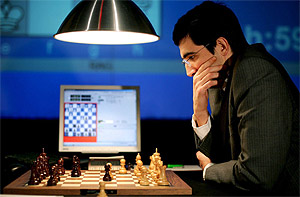
                Deep Fritz, subcampeona, en una partida frente al ruso Kramnik. (Foto: EFE)

                GANÓ DOS PARTIDAS Y FIRMÓ TABLAS EN LAS OTRAS CUATRO

                Deep Junior se proclama primer campeón mundial de ajedrez entre ordenadores

                EFE

                MOSCÚ (RUSIA).- La computadora derrotó a su rival, Deep Fritz, en el primer campeonato mundial oficial de la historia del ajedrez entre ordenadores, después de vencer dos partidas y firmar tablas en otras cuatro.

                Deep Junior ganó dos partidas y empató otras cuatro en el torneo, disputado al mejor de seis partidas y con una bolsa de premios de 60.000 dólares para el ganador y 40.000 para el perdedor, informó el diario digital ruso Newsru.com.

                El torneo se celebró en Elista, capital de la república rusa de Kalmikia, cuyo presidente, Kirsán Iliyumzhínov, también encabeza la Federación Internacional de Ajedrez (FIDE).

                Cada partida de la Copa del Presidente, o Ultimate Computer Chess Challenge, como se conoce este torneo, duró 75 minutos, con cinco segundos para cada movimiento, y un 'time-break' en caso de empate.

                Deep Junior, campeón entre las máquinas en la Olimpiada de ajedrez disputada el pasado año en Turín y considerado por los expertos el favorito a la victoria, abrió con blancas el torneo el pasado 6 de junio.

                El programa de ese ordenador, que utiliza computadoras Intel, fue creado por los israelíes Amir Ban y Shay Bushinski y dispone de varios procesadores, lo que le permite una capacidad de cálculo de más de 500 millones de nodos por segundo.

                Por su parte, Deep Fritz había derrotado en diciembre del pasado año (también por 4-2) al actual campeón mundial de ajedrez, el ruso Vladímir Krámnik, duelo que se celebró también al mejor de seis partidas en Bonn, antigua capital alemana.

                Este ordenador fue programado por el holandés Frans Morsch y el alemán Mathias Feist y, hasta la llegada de Deep Junior, era considerado imbatible.

                Sus autores decidieron hace dos años modificar el programa para introducir en su base de datos una mayor cantidad de información sobre la historia de este juego-ciencia.

                Deep Junior es comparado con el maestro ruso Mijaíl Tal, campeón mundial en 1960 con sólo 24 años; mientras Deep Fritz se parece más al cubano Jose Raúl Capablanca, campeón mundial de 1921 a 1927.

                El primer duelo entre el hombre y la máquina tuvo lugar en 1997, cuando el ahora retirado Garry Kaspárov se enfrentó a la computadora Deep Blue, que se hizo con la victoria por 3,5 puntos contra 2,5.

                IX OPEN DE AJEDREZ DEL SOMAONTANO (HUESCA): JOSÉ LUIS PELLICER CAMPEÓN

                IX OPEN DE AJEDREZ DEL SOMAONTANO (HUESCA): JOSÉ LUIS PELLICER CAMPEÓN
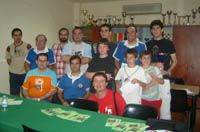
                 El open del Somontano fue un éxito de participación
                José Luis Pellicer se lleva el IX Open de Ajedrez del Somontano
                Las dos rondas finales del IX Open del Somontano ratificaron las posiciones conseguidas la semana anterior, con dos victorias de los primeros clasificados: José Luis Pellicer frente a Luis Gil y Jorge Mancho, mientras que el barbastrense Hugo Güetas ganaba a César Miret y Jaime Puig-Pey. Así, el estadillano José Luis Pellicer conseguía su tercer título en el Torneo, tras los logrados en los años 1999 y 2000, e igualando de esta manera las tres victorias de Hugo Güetas en los años 2004, 2005 y 2006.

                A pesar de todo, la emoción y la lucha por el título siguió hasta la penúltima ronda en la que Luis Gil jugó una excelente partida frente al líder, siendo finalmente sorprendido por el contraataque de Pellicer. Para el resto de clasificaciones, hasta el último segundo de la octava partida hubo chances para muchos de los jugadores, siendo finalmente los desempates los que dieron y quitaron los premios.

                En la clasificación final, tras el pleno de 8 puntos en las 8 partidas de José Luis Pellicer y los 7 puntos de Hugo Güetas se clasificó con 5,5 puntos Jorge Cuello en dura disputa con Javier Palacián que terminó con 5 puntos. Con 4,5 puntos se clasificó César Miret, que consiguió el primer premio para los jugadores de elo hasta 1700. A continuación un numeroso grupo de jugadores con 4 puntos con Jaime Puig-Pey y Luis Gil como premiados por el elo de 1701 a 1900, Jorge Mancho (2º clasificado elo hasta 1700) y ya sin premio José Salas y Luis Coronas.

                Junto al título de José Luis Pellicer, destacó la contundencia del juego de Hugo Güetas, la muy buena progresión del todavía Benjamín Jorge Mancho y la gran lucha desplegada por todos los participantes, con todas las partidas peleadas hasta el final.

                La actividad ajedrecística en el Somontano no cesa y para el domingo por la mañana en la Plaza del Mercado de Barbastro está prevista una nueva edición del “Torneo de Ajedrez Relámpago San Ramón”. Se jugará por sistema suizo a 9 rondas y partidas de 5 minutos.